Telehealth vs in-person TRT: which costs less in Florida?
By Sarah · Updated 2026-07-27
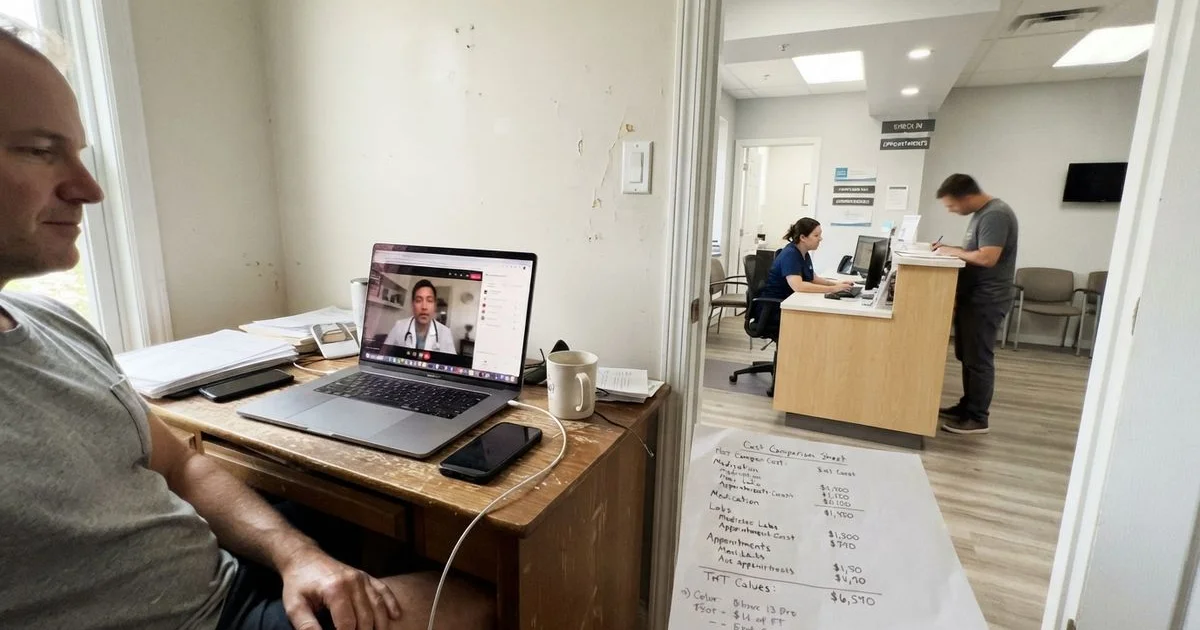
On paper, telehealth and online TRT programs usually come in cheaper than a traditional in-person clinic visit. In practice, the actual savings depend on what’s bundled into each price and whether you value the convenience enough to pay for it either way.
The typical cost gap
A common pattern in Florida: in-person clinic programs often run somewhere around $200 to $250 a month once visits and labs are included, while telehealth programs frequently land closer to $130 to $170 a month for a comparable protocol. That gap, often somewhere in the range of $50 to $100 a month, adds up over a year of treatment, but it’s a general pattern, not a guarantee for any specific provider.
Why telehealth tends to cost less
Telehealth programs skip the overhead of a physical office: no exam rooms, less front-desk staff, lower real estate costs. That savings often gets passed on as a lower monthly rate. Many telehealth programs also standardize their protocols more than in-person clinics do, which can reduce administrative costs on their end.
What you might be trading for the lower price
| Factor | In-person clinic | Telehealth program |
|---|---|---|
| Physical exam | Included at visits | Usually skipped or limited |
| Lab draw | Done on-site, often same visit | Requires a local lab partner or mail-in kit |
| Same-visit adjustments | Possible if labs return quickly | Typically requires a follow-up call after labs are reviewed |
| Provider relationship | Often the same provider each visit | Varies by platform; some rotate providers |
| Convenience | Requires travel and scheduled visits | Manage from home, flexible scheduling |
Neither column is objectively better. It depends on whether you value in-person contact and same-day flexibility, or lower cost and scheduling convenience.

Shipping and lab logistics add up too
Telehealth savings can shrink once you factor in the practical logistics: shipping fees for medication, the time it takes for a mail-in lab kit to reach you and get processed, and any local lab draw fee if your program partners with a nearby facility instead of shipping a kit. None of these are usually dealbreakers, but they’re worth asking about specifically rather than assuming the advertised monthly price is the entire cost.
Hidden costs to check on either side
Advertised monthly rates don’t always tell the full story. On the telehealth side, ask whether lab kits, shipping, and follow-up consultations are included or billed separately. On the in-person side, ask whether the quoted price includes labs and follow-up visits, or just the medication. A lower headline number with several add-on fees can end up costing more than a slightly higher all-inclusive rate. For a broader breakdown of what drives TRT pricing beyond the telehealth-versus-in-person split, see our guide on what changes the price of TRT in Florida.
How to actually compare two quotes
Add up medication, labs, and provider visits for a full year under each option, rather than stopping at the advertised monthly figure. That total is a much more honest comparison than putting two monthly numbers side by side, since what’s bundled into each one can differ significantly.
Who tends to save the most with telehealth
Men with a straightforward case, testosterone that’s clearly low, no complicating health conditions, and a schedule that makes clinic visits inconvenient, tend to be the best fit for telehealth’s lower price point. Men managing other health conditions alongside low testosterone, or who specifically want a provider they can see in person for exams and same-visit adjustments, often find the added cost of an in-person clinic worth it for the closer oversight. Neither path is inherently the better value; it depends on how complex your situation is and how much you weigh convenience against face-to-face contact.
Don’t let price be the only factor
Cost matters, but it shouldn’t be the only thing deciding which type of program you choose. A telehealth program that’s a little more expensive but has responsive support and a clear monitoring plan can be a better value than the cheapest option that leaves you chasing lab results. The same is true in reverse for in-person clinics. Price is one input, not the whole decision.
These figures are general ranges, not a quote for any specific provider. Actual pricing varies by clinic, dose, and whether insurance applies, so confirm the full breakdown before comparing two options.
Our methodology page explains how we score providers on pricing transparency, and you can compare Florida telehealth and in-person options from the Florida TRT Guide homepage.
FAQ
- Is telehealth TRT always cheaper than in-person?
- Usually, but not always. Telehealth programs tend to have lower overhead, but some in-person clinics offer competitive bundled pricing, especially if they're not tacking on concierge-style fees.
- Does telehealth TRT include lab work?
- Most legitimate programs do, either through a local lab partner or a mail-in kit, but it's worth confirming labs are included in the advertised price rather than billed separately.
- What am I giving up by choosing the cheaper telehealth option?
- Mainly in-person physical exams and same-visit adjustments. Some men prefer the convenience of telehealth; others prefer having a provider they see face to face, especially for the first visit.
- Can I switch from telehealth to in-person later, or the reverse?
- Yes, this is common. Some men start with telehealth for convenience and move to an in-person clinic if they want more hands-on monitoring, or the reverse if their schedule changes.